
JIC vs AN Fittings: What Is the Difference?
JIC and AN fittings share a 37° flare and the same thread sizes, but come from different specifications. Here is what that means in practice.
Last updated October 30, 2026. Reference values; verify against manufacturer specifications.
"JIC" and "AN" are often used as if they meant the same thing, especially in motorsport. Both use a 37° flare and the same thread for each dash size, so in most cases the parts screw together and seal. They are still not the same specification. This page explains what they share, where they differ, and when it matters.
The short answer
- Same geometry: JIC and AN fittings both use a 37° flare seat and the same UNF/UN thread for each dash size. A -6 is 9/16-18 in both.
- Different specification: AN fittings come from military and aerospace standards. They are made to a tighter thread class (Class 3 instead of Class 2), with stricter material and inspection rules.
- Do they connect? In general, yes. Several fitting references state that AN and JIC parts of the same dash size assemble and seal. Aerospace work must use the specified AN/MS part, though, and never a commercial JIC substitute.
Where the two names come from
AN stands for Army-Navy. These fittings were standardised for military aircraft, and the flared-tube fittings were covered by a military specification, MIL-F-5509. That document has since been cancelled and superseded, but the AN part standards are still in use. The JIC (Joint Industry Council) 37° fitting was based on the AN design and adapted for industrial hydraulics. That design is now defined by SAE J514 and ISO 8434-2.
Because JIC grew out of AN, the two kept the same flare angle and the same thread for each dash size. That is why so many charts list them together.
Shared seat angle
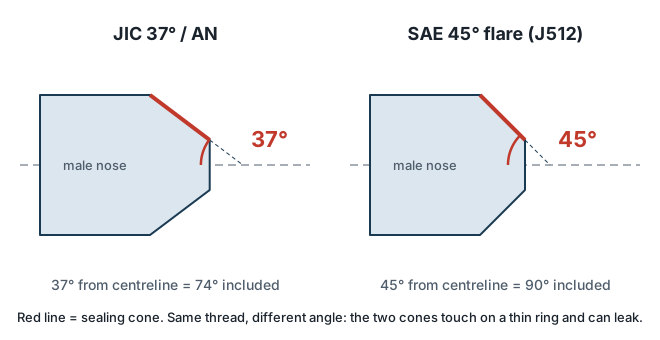
Both systems seal metal-to-metal on a 37° cone. The angle is measured from the centreline, so the included angle is 74°. Neither seals properly against an SAE 45° flare. The two angles touch on a thin ring rather than a full face.
Shared sizes and threads
The dash number is the tube outside diameter in sixteenths of an inch, in both systems. The table shows the sizes most often seen on AN fittings. The full range, with male OD and female ID, is in the JIC fitting size chart.
| Dash | Tube OD (in) | Tube OD (mm) | Thread (JIC and AN) | TPI |
|---|---|---|---|---|
| -3 | 3/16 | 4.76 | 3/8-24 | 24 |
| -4 | 1/4 | 6.35 | 7/16-20 | 20 |
| -5 | 5/16 | 7.94 | 1/2-20 | 20 |
| -6 | 3/8 | 9.53 | 9/16-18 | 18 |
| -8 | 1/2 | 12.70 | 3/4-16 | 16 |
| -10 | 5/8 | 15.88 | 7/8-14 | 14 |
| -12 | 3/4 | 19.05 | 1-1/16-12 | 12 |
| -16 | 1 | 25.40 | 1-5/16-12 | 12 |
| -20 | 1-1/4 | 31.75 | 1-5/8-12 | 12 |
Because the threads match, you cannot tell a JIC fitting from an AN fitting by measuring the thread. Look at the markings, the material and the source of the part instead.
JIC vs AN at a glance
| Feature | JIC 37° (SAE J514) | AN 37° (military / aerospace) |
|---|---|---|
| Flare angle | 37° from centreline (74° included) | 37° from centreline (74° included) |
| Thread sizes | UNF -2 to -10, 12-UN from -12 | Same sizes and pitches |
| Thread class | Class 2A / 2B (standard commercial fit) | Class 3A / 3B (tighter tolerance); some references describe a rounded-root UNJ form |
| Governing documents | SAE J514, ISO 8434-2 | AN/MS part standards (e.g. AN818 nut); historically MIL-F-5509, now cancelled and superseded |
| Typical materials | Plated carbon steel, stainless steel, brass | Aluminium alloy, steel and stainless steel |
| Typical uses | Industrial, mobile and agricultural hydraulics | Aircraft; widely adopted in motorsport fuel, oil and brake lines |
| Traceability | Commercial part | Aerospace parts carry specification and lot traceability |
What the thread class difference means
A thread "class" sets how much tolerance the thread is allowed. Class 2A (external) and 2B (internal) are the normal commercial grade used on most bolts and on JIC fittings. Class 3A and 3B allow less variation, so parts fit more closely and more consistently.
A Class 3 AN thread will normally assemble with a Class 2 JIC thread of the same size, because the pitch and nominal diameter are the same. The fit is simply less tightly controlled. The seal is on the 37° cone, not on the threads, so the thread class affects how well the joint holds and lines up rather than whether it seals.
Materials: aluminium AN vs steel JIC
Most industrial JIC fittings are plated steel. Many AN-style fittings sold for motorsport are anodised aluminium, chosen to save weight. This matters more than the thread class:
- Torque: aluminium needs much less torque than steel. When an aluminium AN nut meets a steel JIC adapter, use the value for the softer metal. That is the same rule Parker gives for dissimilar metals. Steel reference values are in the JIC torque chart.
- Seat damage: an aluminium cone or seat deforms easily if over-tightened. Once flattened, it may never seal again.
- Pressure and temperature: an aluminium fitting usually carries a lower pressure rating than a steel fitting of the same size. Check the rating of every part in the line, including the hose.
When you can mix JIC and AN
- Industrial and mobile hydraulics: an AN fitting of the same dash size will connect to a JIC fitting. Rate the joint by the weaker part.
- Motorsport: mixing is common. Pay attention to material and torque, and to the hose maker's assembly instructions.
- Aircraft: do not substitute. Use only the part number the maintenance data calls for.
How to tell an AN fitting from a JIC fitting
- Check the markings and paperwork. Aerospace AN/MS parts carry part numbers such as AN818 (coupling nut) or AN819 (sleeve) and come with traceability. Commercial JIC parts usually carry a maker's mark only.
- Check the material. Coloured anodised aluminium points to AN-style motorsport fittings. Plated steel is typical of JIC.
- Measure anyway. Confirm the size with the fitting identification guide. The thread and the 37° angle should match one row of the chart, whichever name the part is sold under.
Related comparisons
The 37° vs 45° question applies to AN fittings too. See JIC vs SAE 45° flare. For the metric equivalents of each AN/JIC dash size, see the JIC metric conversion chart.
The standard behind JIC fittings is described on SAE J514 explained.
References
Parker AN/MS fitting technical data; PCC Fluid Fittings flared fitting catalog; the DLA specification index for MIL-F-5509; Tameson JIC vs AN guide; Delphi Fittings AN vs JIC guide; Maxbar SAE J514 end-fitting data; the fittingkey JIC vs AN comparison; Parker Catalog 4400 for dissimilar-metal torque guidance. Values are reference only.
Frequently asked questions
Are AN and JIC fittings interchangeable?
In most non-aerospace uses, yes. They share the 37° flare and the same thread for each dash size, so they assemble and seal. Aircraft work must use the specified AN or MS part.
What is the difference between AN and JIC threads?
The size and pitch are the same. AN threads are made to a tighter Class 3A/3B tolerance, while JIC uses the standard Class 2A/2B fit.
Is -6 AN the same size as -6 JIC?
Yes. Both are for 3/8 in tube and use a 9/16-18 UNF thread with a 37° seat.
Can I use AN fittings with SAE 45° flare?
No. AN fittings use a 37° seat, like JIC. A 45° flare seat will not seal properly against them, even where the threads match.
Why are AN fittings often aluminium?
AN-style fittings are widely used in aircraft and motorsport, where weight matters. Aluminium is lighter, but it needs lower torque and is easier to damage than steel.
Do AN fittings need thread sealant?
No. Like JIC, AN fittings seal on the 37° flare, not on the threads. Follow the maker's advice on thread lubrication.