
How to Identify JIC Fittings
Check the sealing surface, the thread diameter and the pitch. Use the finder below to match your measurements against JIC and its look-alikes.
Last updated October 30, 2026. Reference values; verify against manufacturer specifications.
Identifying a hydraulic fitting comes down to three checks: the sealing surface, the thread diameter and the thread pitch. A JIC fitting has a 37° cone, an inch UNF or UN thread, and a dash size that matches the tube OD in sixteenths of an inch. This page walks through each check, gives a finder that matches your measurements against JIC and its look-alikes, and lists the fittings most often mistaken for JIC.
Identify my fitting: OD and TPI finder
Measure the thread with calipers and enter the reading, plus the threads per inch if you have a thread gauge. The finder compares the measurement against JIC, SAE 45°, ORB, ORFS, NPT, BSP/JIS and common metric threads. It shows every family that fits, because several families share the same thread.
Identify my fitting: OD + TPI finder
Checks JIC, SAE 45°, ORB, ORFS, NPT, BSPP/BSPT/JIS and common metric threads. Nothing you enter leaves your browser.
What you need
- Calipers, digital or dial, reading to 0.01 in or 0.1 mm.
- A thread pitch gauge with inch (TPI) and metric leaves. A Whitworth 55° gauge helps with BSP.
- A seat angle gauge (optional but useful) for 37°, 45°, 24° and 30° seats.
- A clean rag. Dirt on the threads adds to the reading.
Step 1: Look at the sealing surface
The seal tells you more than the thread does, because several families use the same thread. Start here.
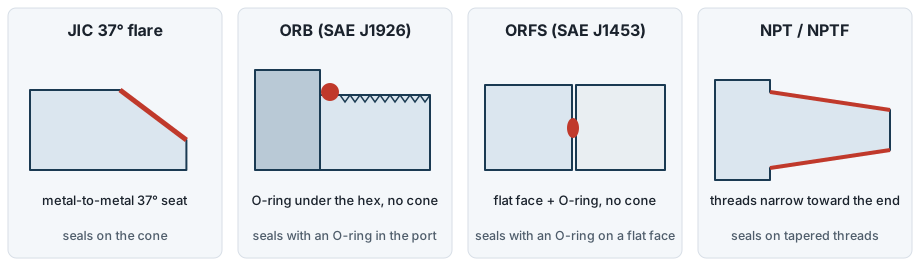
| What you see | Likely family | Next check |
|---|---|---|
| Male with a convex cone nose, cone about 37° | JIC (or AN) | Measure the thread; JIC and AN share sizes |
| Male with a convex cone nose, cone about 45° | SAE 45° flare | Seat gauge; see the 45° guide |
| Male with a convex cone nose, about 24°, metric thread | DIN 24° metric | Metric thread gauge |
| Male with a concave (recessed) 30° seat | JIS 30° (Japanese) | BSP or metric thread gauge |
| Flat face with an O-ring groove | ORFS | Thread size per the ORFS table |
| O-ring under the hex, straight thread, no cone | ORB (SAE J1926) | Thread size; same threads as JIC |
| No seat; the thread gets smaller toward the end | NPT or BSPT | Thread angle and TPI |
| 60° cone on a BSP-size thread | BSPP hose end | Whitworth 55° gauge |
JIC and SAE 45° look almost identical. Both have a convex cone on the male end, but the angles differ by 8°:
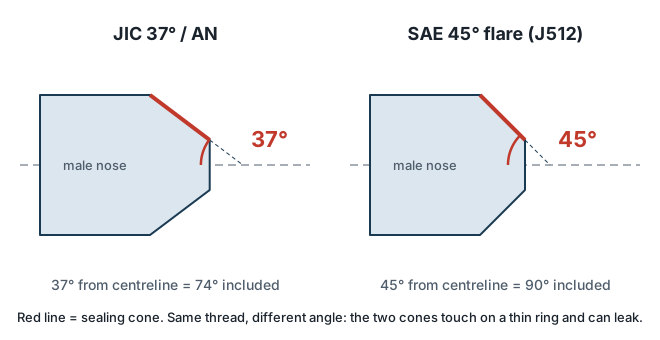
To tell them apart without a gauge, hold the male fittings side by side if you have one of each. The 45° cone looks noticeably blunter. The JIC vs SAE 45° flare guide covers this in detail.
Step 2: Measure the thread diameter
For a male thread, measure the outside diameter across the crests. For a female thread, measure the inside diameter across the inner crests. Take readings at two or three points and use the largest steady reading. Worn threads read low. The how to measure JIC fittings guide shows jaw placement step by step.
Compare the reading with the JIC fitting size chart. A male -6 JIC measures about 0.56 in (14.3 mm). A male -8 measures about 0.75 in (19.1 mm).
Step 3: Measure the thread pitch
Hold thread gauge leaves against the thread until one sits flush with no light showing. JIC fittings use 24, 20, 18, 16, 14 and 12 TPI. If you only have a metric gauge, a 1.41 mm pitch is 18 TPI and 1.59 mm is 16 TPI. A pitch of 19 or 11 TPI means BSP, and 11.5 TPI on a tapered thread means NPT. Metric pitches such as 1.5 mm point to DIN or JIS-metric fittings; see the JIC metric conversion chart.
Step 4: Confirm the size and family
With seat, diameter and pitch known, the family is usually clear. If more than one family still matches, the seat decides. Watch out for the pairs in this table, which cause most identification mistakes:
| JIC size (thread) | Look-alike | Look-alike thread | How to tell them apart |
|---|---|---|---|
| -4 (7/16-20) | SAE 45° -4; ORB -4 | 7/16-20 (same) | 45°: seat angle. ORB: O-ring under the hex, no cone |
| -5 (1/2-20) | SAE 45° -5; ORB -5; G1/4 BSP | 1/2-20 (same); G1/4 19 TPI | BSP: 55° thread angle and 19 TPI |
| -6 (9/16-18) | ORB -6; ORFS -4; 1/4 NPT | 9/16-18 (same); 9/16-18 (same); 1/4-18 NPT | ORFS: flat face. NPT: tapered, about 0.54 in |
| -6 (9/16-18) | SAE 45° -6 | 5/8-18 | Same TPI, 45° -6 is about 1.6 mm larger |
| -8 (3/4-16) | SAE 45° -8; ORB -8 | 3/4-16 (same) | Seat angle (45°) or O-ring (ORB) |
| -10 (7/8-14) | SAE 45° -10; ORB -10 | 7/8-14 (same) | Seat angle (45°) or O-ring (ORB) |
| -10 (7/8-14) | 1/2 NPT; G1/2 and G5/8 BSP | 1/2-14 NPT; G1/2-14; G5/8-14 | NPT: taper. BSP: 55° thread angle |
| -12 (1-1/16-12) | SAE 45° -12 | 1-1/16-14 | Same diameter; pitch 12 vs 14 TPI |
| -12 (1-1/16-12) | G3/4 BSP; 3/4 NPT | 14 TPI | Pitch: 12 vs 14 TPI |
| -14 (1-3/16-12) | ORFS -12 | 1-3/16-12 (same) | ORFS: flat face with O-ring |
| -16 (1-5/16-12) | G1 BSP; 1 NPT | G1-11; 1-11½ NPT | Pitch: 12 vs 11 or 11.5 TPI |
| -24 (1-7/8-12) | G1-1/2 BSP | G1-1/2-11 | Pitch: 12 vs 11 TPI |
JIC per SAE J514; look-alike threads from the Eaton and McGill thread identification guides, which agree on these sizes. Detailed comparisons: JIC vs ORB, JIC vs ORFS, JIC vs NPT, JIC vs BSP, JIC vs JIS.
The two most common sizes have their own pages with every look-alike listed: -6 JIC (9/16-18) and -8 JIC (3/4-16).
JIC vs AN: a special case
AN (Army-Navy) fittings also use a 37° flare and the same thread sizes as JIC. Outside aerospace, AN and JIC parts of the same dash size generally assemble and seal. The differences are in thread class and specifications, which calipers and a pitch gauge cannot detect. See JIC vs AN fittings.
Common identification mistakes
- Using the nominal size. A "1/4 in" JIC fitting does not have a 1/4 in thread. -4 JIC is 7/16-20. Always measure.
- Measuring the female from the wrong surface. Measure across the thread crests inside, not the opening of the nut.
- Trusting diameter alone. -6 JIC, -6 ORB and -4 ORFS share 9/16-18. Only the seat separates them.
- Counting threads over less than an inch. 11 and 12 TPI are only one thread apart per inch.
More pitfalls are listed in common JIC fitting mistakes, and the difference between the two halves of a joint is explained in male vs female JIC fittings.
For pitch and dash lookups, use the JIC thread pitch chart and the JIC dash size chart. The shapes JIC fittings come in are on JIC fitting types.
References
SAE J514 JIC dimensions as published by Parker and Eaton; Eaton Thread Identification Guide; McGill Hose thread identification guide. Values are reference only.
Frequently asked questions
How do I know if a fitting is JIC?
Look for a 37° cone on the male end (or a matching seat inside the female nut). Then measure the thread: JIC uses inch UNF or UN threads such as 7/16-20 (-4), 9/16-18 (-6) and 3/4-16 (-8).
What does the dash number mean on a JIC fitting?
The dash number is the tube OD in sixteenths of an inch. A -8 JIC fits 8/16 in, or 1/2 in, tube. It does not equal the thread size.
Can I identify a JIC fitting by the thread alone?
Not always. JIC, ORB and SAE 45° share threads in several sizes, and -4 ORFS uses the -6 JIC thread. Check the seat as well.
What tools do I need to identify hydraulic fittings?
Calipers, a thread pitch gauge with inch and metric leaves, and ideally a seat angle gauge.
Is my data sent anywhere when I use the finder?
No. The finder runs entirely in your browser using a data file on this site.